
The body is always honest—even when the mind says ‘I’m fine.
I want to tell you something personal before we talk about your pet.
I see my acupuncturist regularly. It’s part of how I take care of myself — not because something is “wrong,” but because I believe in catching things before they become problems. This past week, he told me my liver was really tight.
Now, if you know anything about Chinese medicine, you know the liver holds the emotions of stress and anger. And here’s the thing — if you’ve met me in real life, you’d probably think I never get stressed or angry for a day in my life. And honestly? Even to myself, I didn’t feel like I was carrying stress or anger about anything in particular.
But February was an incredibly busy month. The construction timeline for our new space hit delays. Things I couldn’t control weren’t going the way they needed to. And while I thought I was handling it all just fine — my body told a different story. My liver was holding emotions that my conscious mind hadn’t even registered yet.
That’s the thing about emotions. They don’t need your permission to live in your body. They just move in.
And your pet? They’re no different.
“Anxiety” has become one of the most common words I hear from pet parents walking through our doors. And I understand why — especially after the pandemic, when our lives changed and so did theirs. Dogs who had us home 24/7 suddenly had us gone again. Cats who finally had a predictable routine watched it dissolve overnight. And we started seeing more pacing, more reactivity, more destruction, more clinginess, more of the behaviors that we’ve collectively filed under one big umbrella: anxiety.
But here’s what I’ve learned after years of practicing integrative medicine: anxiety is almost never just anxiety.
It’s a catchall term. A surface label for something much deeper and more specific happening underneath. And if we only treat the surface — if we go straight to calming supplements or anti-anxiety medications without asking what is this pet actually feeling — we might manage the symptoms. But we’ll miss the story.
Let me give you two real examples from our practice.
The dog who couldn’t feel clean. A pet came to us with what looked like classic anxiety — restless, agitated, clearly uncomfortable. The trigger? A flea exposure. Now, fleas can certainly cause physical discomfort. But even after the fleas were gone, this dog couldn’t settle. When we looked deeper, we found that the underlying emotion wasn’t fear or general anxiety — it was a feeling of being contaminated. Of not feeling clean. The physical event was over, but the emotional imprint was still running the show.
We used a Bach flower essence called Crab Apple — known as the cleansing remedy — to address that specific emotional pattern. And during that period, the patient returned to a noticeably calmer state. Not because we sedated the anxiety. Because we addressed what was actually underneath it.
The rescue who wouldn’t leave the house. Another pet came to us labeled “anxious.” She was a rescue — multiple homes, multiple surrenders. And her anxiety looked like refusal. She wouldn’t leave the house. She’d freeze at the door. She resisted walks, car rides, any change in routine.
Everyone saw an anxious dog. But when we looked at her story, what we found was a deep, specific fear of change — because every major change in her life had meant losing the family she’d grown attached to. She wasn’t anxious. She was terrified of being abandoned again. She was holding on to the only stable thing she had — the house, the routine, the sameness — because in her experience, change meant loss.
That’s not a calming supplement problem. That’s a grief and trust problem. And it requires a completely different approach.
This is why I’m so passionate about the tools we use at IPWC — because they let us look beneath the label and find the real emotional landscape.
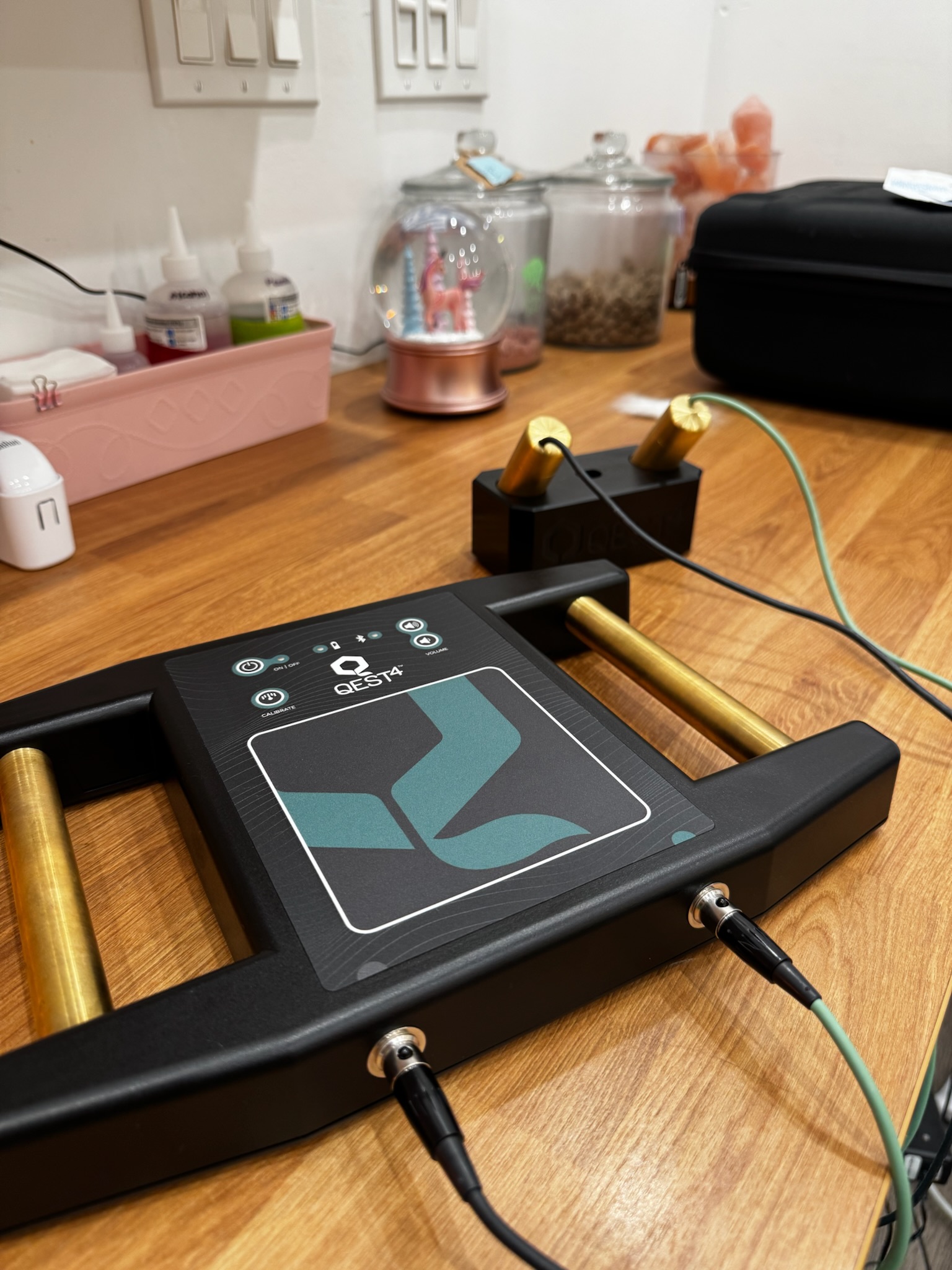
Bioresonance Scanning (Qest4)
One of the tools we use is called a Qest4 bioresonance scan. It works on the principles of quantum healing by measuring your pet’s energetic frequencies — essentially reading the body’s subtle energy field to identify patterns that haven’t yet shown up as physical disease.
What does that mean in plain language? It means we can detect emotional signatures — specific emotions that your pet may be holding in their body — as well as early energetic patterns that could eventually develop into illness if left unaddressed. Think of it as a conversation with your pet’s body at the deepest level, before symptoms become diagnoses.
For a pet labeled “anxious,” a Qest4 scan might reveal that the underlying pattern isn’t generalized anxiety at all. It might show grief. Fear of abandonment. A lack of safety. A deep-seated emotion tied to a specific experience. And once we know what we’re actually looking at, we can match the right support to the right need — instead of guessing.
Bach Flower Essences
Bach flower essences are one of my favorite tools for emotional healing because they’re gentle, they’re specific, and they work on the emotional body directly. There are 38 individual remedies in the Bach system, each one corresponding to a specific emotional state. Here are a few that come up often in our patients:
Mimulus — for known, specific fears. The dog who is afraid of thunderstorms, loud noises, or a particular person. They know exactly what scares them, and so do you.
Aspen — for vague, unexplained anxiety. The pet who seems uneasy but you can’t pinpoint why. There’s no obvious trigger — just a general sense of apprehension, as if something bad is about to happen.
Star of Bethlehem — for past trauma. This is one of the most important remedies for rescues and rehomed pets. It addresses the emotional shock and grief of past experiences that the pet may still be carrying in their body — even years later.
Walnut — for difficulty with change and transitions. The pet who falls apart when you move, travel, change your schedule, or bring a new animal into the home. Walnut helps provide emotional protection during periods of adjustment.
Crab Apple — the cleansing remedy. For pets who feel “contaminated” or unsettled after a physical event — like our flea patient. It addresses the emotional residue that lingers after the physical trigger is gone.
Chicory — for possessiveness, clinginess, and fear of losing love. The pet who can’t let you out of their sight, who follows you room to room, who panics when you leave. Often underneath what looks like separation anxiety is a deep need to hold on to love — sometimes rooted in early experiences of being given away.
These aren’t sedatives. They don’t suppress anything. They gently help the emotional body return to balance — which, over time, allows the behaviors we see on the surface to shift on their own.
Here’s what I keep coming back to, both for my own health and for the patients I care for:
The body is always honest. Even when the mind says “I’m fine,” the body tells the truth. My liver told my acupuncturist what I wasn’t admitting to myself. Your pet’s behavior is telling you something they can’t say in words.
And the whole point of preventive, integrative medicine — acupuncture, herbal medicine, flower essences, bioresonance scanning — is to listen to those messages before they become disease. Before the emotional pattern that’s been quietly running in the background finally translates into a physical problem that’s much harder to unwind.
So if your pet has been labeled “anxious” and nothing seems to fully help — I want you to consider that maybe we haven’t found the right question yet. Maybe it’s not anxiety. Maybe it’s grief. Maybe it’s fear of abandonment. Maybe it’s a feeling of not being safe, or not being clean, or not being worthy of staying.
And maybe your pet has been trying to tell you that all along.
If this resonates, this is exactly the kind of work we do at IPWC. We’d love to start with a Qest4 bioresonance scan to understand your pet’s emotional and energetic landscape, and from there, build a plan that actually addresses what’s underneath — not just what’s on the surface.
Because extraordinary care means asking the deeper question. Always. 💜
P.S. — I recently sat down with an incredible dog behavior expert on the podcast who said something that stopped me in my tracks: “Replace the word training with learning and observing, and everything falls into place.” If your pet is struggling with behavior, reactivity, or what you’ve been calling anxiety — give that episode a listen. Sometimes the answer isn’t more control. It’s more understanding. Check out the episode this week. 🦄